

What is a Distribution Transformer?
Distribution Transformer is an electrical isolation transformer which convert high-voltage electricity to lower voltage levels acceptable for use in homes and business. A distribution transformer’s function is straightforward: to step down the voltage and provide isolation between primary and secondary. Electrical energy is passed through distribution transformers to reduce high-distribution voltage levels down to end-use levels. Nearly all energy passes through at least one distribution transformer before being consumed by an end-use appliance, motor, or other piece of equipment. Distribution Transformers are found in all sectors of the economy: residential, commercial, and industrial.
Distribution transformers are generally categorized in several ways:
- type of insulation: Oil-immersed or dry-type
- number of phases: single-phase or three-phase
- voltage level (for dry-type): low or medium
General Purpose Distribution Transformers.
They are generally used for supply appliance, lighting, motorized machine and power loads from electrical distribution systems. They are either ventilated or totally enclosed, and are available with either aluminum or copper windings in standard ratings from 100KVA up to 3000 kVA.
Since small distribution transformers do not generate much heat, a higher proportion of theses tend to be dry-type. Dry-types are less flammable, and are therefore often selected for use when they must be located in confined spaces on a customer’s premises. Distribution transformers are used in electric power systems. The final part of the distribution system at medium voltage are the distribution transformers. Due to the low impedance voltage, this type of power distribution transformer will not substantially limit the short circuit current in the case of a fault on its secondary side. It is therefore common practice that power distribution transformers have to be type tested to their ultimate short-circuit conditions. Power distribution transformers may be oil filled or dry-filled. Distribution Transformers consist of two primary components: Core and Coil. Coil is a conductor, or winding, typically made of a low resistance material such as aluminum or copper. Copper or aluminum conductors are wound around a magnetic core to transform current from one voltage to another. Liquid insulation material or air (dry-type) surrounds the transformer core and conductors to cool and electrically insulate the transformer.
A core made of magnetically permeable material like grain oriented steel.
Distribution transformers are either mounted on an overhead pole or on a concrete pad at ground level. There is some evidence to suggest that pole mounted transformers dissipate heat more easily than pad mounted units and may therefore be more fully loaded.
What is Switchgear? Features, components and classifications
Switchgear plays a vital role in the overall power distribution and consumption system. Generally speaking, switchboards are the term one uses to designate low voltage switching whereas switchgear connotes HT usage scenarios.
The switchgear system
The term “switch” brings to mind a device that makes or breaks an electrical contact. In the industrial and LT/HT context switchgear is more complex as switchgear dealers will tell you. Switchgear is typically classified into categories like low voltage/low tension switchgear, medium voltage switchgear and high voltage-high tension switchgear. A typical system has the power components and control system with a variety of safety and monitoring features. One of the best names in the switchgear business is Larsen & Toubro. L&T Switchgears are the first choice of industries and power distribution companies for their total reliability and faultless performance.
The term switchgear refers to a collection of various devices such as:
- Fuses
- Circuit breakers
- Isolators
- Relays, coils
- Disconnect switches
- Current transformers for sensing and monitoring as well as protection
All these components of switchgear may be contained in a suitable metal cabinet that is usually earthed for safety reasons. However, HT distribution systems with large circuit breakers and switchgear are usually housed in a building.
Apart from switching on and off electricity supply, switchgear must also control power to the load, detect overload conditions and have features to automatically trip, such as circuit breakers. This protects the equipment that consumes power and it also keeps cables and switchgear protected. Switchgear may also have multiple sources of supply and automatically switch load in case one source fails.
Switchgear and protection may be automated or manually operated though the former is preferable since the automated system detects overloads and short-circuits and immediately disconnects supply thus preventing a major hazard.
Some more features of switchgear:
The household switch you are familiar with usually has air as the isolating medium since air is an insulator. However, when it comes to HT/LT applications where voltages and currents may be quite high then the circuit breakers may be oil immersed, gas or even vacuum insulated. Some switchgear makes use of the hybrid model incorporating air and gas technologies. The main reason for using gas, air or vacuum is to quench the arc caused at the time of pulling contacts apart. For instance, medium voltage switchgear operates at around 11000 volts and this high a voltage can cause quite a spark. Vacuum circuit breakers are usually employed here.
Switchgear may be classified according to voltage and current rating, by the choice of insulating medium and the interrupting rating or the short circuit current that the device can handle. Then there are further sub-classifications possible such as manual/motorized or solenoid operated as well as the transmission and distribution system. Switchgear may be purposed for isolation purposes, as load break switches and as grounding switches too in high voltage switchgear, medium voltage and low voltage switchgear.

Application
Indoor / Outdoor Vacuum Circuit Breaker panel used to Control and protection of the power supply to motors, transformers, capacitors and other feeder circuits. Designed for indoor / outdoor use and is particularly suitable for
Electric power plants
Substations
Industrial plants
Commercial buildings
Pumping stations
Pipeline stations and
Transportation systems.
Large infrastructures: Airports, railways, etc.
Power stations: Wind farms
Utilities: Primary distribution substations
Industry: Chemical, Iron and steel, automobile, etc.
VCBs are available at rated voltage of 11KV, with rated short-circuit breaking capacities from 20 to 31.5 KA type of fixed & withdrawable.
SALIENT FEATURES
HIGH RELIABILITY:
Testing is performed by an independent testing team. Fully Insulated Design and all the operations are behind the closed doors. All components, such as current transformers, voltage transformers and multifunction relays are made of the highest quality materials. Our new generation design has reduced the number of parts, which reduces the chance of failure.
SAFETY:
Compartment partitions and an automatic shutter system completely isolate live parts. Comprehensive interlocking mechanisms are used for Safe Operations. MAX VCBs are designed to withstand the huge pressure and burning effect of the arc to withstand in the event of an internal arc fault.
HIGH PROTECTION:
Specially designed Multiple Protection Relays are installed to provide protection, measurement, and communications and control functionality.
FLEXIBLE DESIGN FOR EASY INSTALLATION:
Flexible features like readily extensible, Panels with main circuit and control cable entry from either the top or bottom are available for easy installation. Installation and testing duration are considerably reduced as the panel is tested in the factory and then delivered as a complete unit.
Technical Data
| STANDARD TECHNICAL FEATURES OF MAX SERIES CIRCUIT BREAKER PANELS | ||||||
|---|---|---|---|---|---|---|
| TYPE | VMAX12 | |||||
| Rated Voltage (kV) | 12 | |||||
| Frequency (Hz) | 50 | |||||
| Rated Insulation level (1 min) kV rms | 28/36 | |||||
| 1.2/50 micro sec. impulse (kV peak) | 75/95 | |||||
| Rated Current A | 630/1250/1600/2000 | |||||
| Rated short time current rating (3 Sec) | 1-3 sec | |||||
| Rated short circuit breaking current (kA) | 20/25/31.5 | |||||
| Operating Duty | 0-3 min-co-3 min-co | |||||
| Operating time | < 70ms | |||||
| Operating Cycles | < 2 Cycles | |||||
| Note: The standard specifications vary from time to time as our products undergo continuous developments | ||||||

Application
One of the basic functions of switch gear is protection, which is interruption of short-circuit and overload fault currents while maintaining service to unaffected circuits. Switch gear also provides isolation of circuits from power supplies. Switch gear is also used to enhance system availability by allowing more than one source to feed a load
Construction
This protective equipment is used for the 11KV voltage system, Load break switch (LBS) mechanism is available for 630A, and over current protection scheme is done through HRC fuse, The panel includes 3 Numbers of CT (Current transformer) and 2 Numbers of PT (Potential transformer) for measuring system current and voltage, The HRC fuse protect overload or any short circuit, The panel also includes 3 numbers of Ampere meter & one voltmeter with a selector switch for monitoring different
The Construction is of metal clad type and uses high grade steel of adequate thickness ensuring safety and security, the panel size is 900 mm x 1000 mm x 1800 mm and weight almost 450kG.
Key feature
Long Maintenance free operation
Fully metal clad design
Horizontal isolation
Very High Operating Reliability
Simple Maintenance and Inspection
High Dynamic and Thermal Strength
Special Bottle Arc-chutes
Current Interruption without visible arcs
Simple Driving Mechanism
Fire Chamber
Push off System
Technical Data
We Power Generation Technology manufacture and supply HT Load Break Switches ranges from 6.66kV to 11kV with the amp rating 630. Our 11kV LBS switchgear panels are compact in size to suite every industrial needs. Available Indoor and Outdoor type Load break switches for varied range of applications
| Technical Specification11kV Series Load Break Switchgear Panels | |||
|---|---|---|---|
| Model | LMAX16325 | ||
| Rated Voltage | 12 KV | ||
| Rated Frequency | 50 Hz | ||
| Rated Current | 630 A | ||
| Rated Peak Current | 62.5 KA | ||
| Rated Short time current / 1 sec. | 26.3 KA (3 sec) | ||
| Rated Making Current | 20 KA | ||
| Rated Breaking Current | 25 KA | ||
| Impulse Voltage, Wave Shape 1.2/50 MS | |||
| i) To Earth | 75 KV | ||
| ii) Between Poles | 75 KV | ||
| iii) Between Open Contacts | 85 KV | ||
| Power Frequency Test Voltage | |||
| iv) To Earth | 28 KV | ||
| v) Between Poles | 28 KV | ||
| vi) Between Open Contacts | 35 KV | ||
| Breaking of Capacitance Load | 50 A | ||
| Closed Loop Breaking Current COS ф = 0.31 ND | 630 A | ||
| Rated Transformer Off Load Breaking Capacity | 120 A | ||
| Rated Line Charging Breaking Capacity | 90 A | ||
| Rated Cable Charging Breaking Capacity | 90 A | ||
| Dimensions (Ref. Drg. Enclosed) | |||
| i) Between Poles (Centers) mm | 150-210 | ||
| ii) Between Open Contacts mm | 140 | ||
| iii) Between live parts and earth mm | 130 | ||
| Making Time 35 M. Sec | |||
| Arc Duration 5-20 M. Sec | |||

Generally electrical switchgear rated upto 600V is termed as low voltage switchgear. The term LV Switchgear includes low voltage circuit breakers, switches, off load electrical isolators, HRC fuses, RCD, RCCB, ACB earth leakage circuit breaker, miniature circuit breakers (MCB) and molded case circuit breakers (MCCB) etc i.e. all the accessories required to protect the LV system. The most common use of LV switchgear is in LV distribution board. This system has the following parts
Incomer
The incomer feeds incoming electrical power to the incomer bus. The switchgear used in the incomer should have a main switching device. The switchgear devices attached with incomer should be capable of withstanding abnormal current for a short specific duration in order to allow downstream devices to operate. But it should be cable of interrupting maximum value of the fault current generated in the system. It must have an interlocking arrangement with downstream devices. Generally air circuit breakers are preferably used as interrupting device. Low voltage air circuit breaker is preferable for this purpose because of the following features
1. Simplicity
2. Efficient performance
3. High normal current rating up to 6300 Amp.
4. High fault withstanding capacity upto 63 kA
Although air circuit breakers have long tripping time, big size, high cost but still they are most suitable for low voltage switchgear for the above-mentioned features.
Sub – Incomer
Next downstream part of the LV Distribution board is sub – incomer. These sub-incomers draw power from main incomer bus and feed this power to feeder bus. The devices installed as parts of a sub – incomer should have the following features
1. Ability to achieve economy without sacrificing protection and safety
2. Need for relatively less number of interlocking since it cover limited are of network.
ACBs (Air Circuit Breakers) and switch fuse units are generally used as sub – incomers along with molted case circuit breakers (MCCB).
Feeders
Different feeders are connected to the feeder bus to feeds different loads like, motor loads, lighting loads, industrial machinery loads, air conditioner loads, transformer cooling system loads etc. All feeders are primarily protected by switch fuse unit and in addition to that, depending upon the types of load connected to the feeders, the different switchgear devices are chosen for different feeders. Let us discuss in details
• Motor Feeder
• Motor feeder should be protected against over load, short circuit, over current up to locked rotor condition and single phasing.
• Industrial Machinery Load Feeder
• Feeder connected industrial machinery load like oven, electroplating bath etc are commonly protected by MCCBl and switch fuse disconnector units
• Lighting Load Feeder
• This is protected similar to industrial machinery load but additional earth leakage current protection is provided in this case to reduce any damage to life and property that could be caused by harmful leakages of current and fire.
In LV switchgear system, electrical appliances are protected against short circuit and overload conditions by electrical fuses or electrical circuit breaker. However, the human operator is not adequately protected against the faults occurs inside the appliances. The problem can be overcome by using an earth leakage circuit breaker. This operates on low leakage current. The earth leakage circuit breaker can detect leakage current as low as 100 mA and is capable of disconnecting the appliance in less than 100 msec.
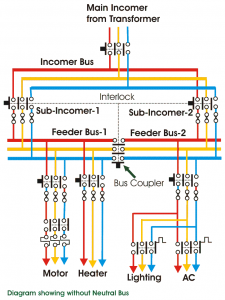
A typical diagram of low voltage switchgear is shown above. Here the main incomer comes from LV side of an electrical transformer. This incomer through an electrical isolator as well as an MCCB (not shown in the figure) feeds the incomer bus. Two sub-incomers are connected to the incomer bus and these sub-incomers are protected by means of either switch fuse unit or air circuit breaker. These switches are so interlocked along with bus section switch or bus coupler that only one incomer switch can be put on if bus section switch is in on position and both sub incomer switches can be put on only if bus section switch is at off position. This arrangement is fruitful for preventing any mismatch of phase sequence between the sub – incomers. The different load feeders are connected to any of both sections of the feeder bus. Here motor feeder is protected by thermal overload device along with conventional switch fuse unit. Heater feeder is protected only by conventional switch fuse unit. The domestic lighting and AC loads are separately protected by a miniature circuit breaker along with common conventional switch fuse unit. This is most basic and simple scheme for low voltage switchgear or LV distribution board.
6

General Description:
To obtain the best possible economic advantage from electric power both the generating plant and consumers plants should be operated at high efficiency. To achieve this it is essential to have a high power factor throughout the system.
Most a.c. electric machines draw from the supply apparent power in terms of kilovolt-amperes (KVA) which is in excess of the useful power measured in kilowatts(KW) required by the machine. The ratio of these quantities
Useful power/Apparent power or KW/KVA =Power factor (cos φ)
is known as the power factor of the load and is dependent upon the type of machine in use. A large proportion of the electric machinery used in industry has an inherently low power factor, which means that the supply authorities have to generate much more current than is theoretically required. In addition, transformers and cables have to carry this extra current. When the overall power factor of generating station’s load is low, the system is inefficient and the cost of electricity correspondingly high. To overcome this, and at the same time ensure that the generators and cables are not overloaded with wattles current, the supply authorities often offer reduced terms to consumers whose power factor is high or impose penalties for low power factor.
Reductions in power costs can be made by taking advantage of these special terms.
Definition: The power factor of a load is defined as the ratio of active power to apparent power, i.e. KW:KVA and is referred to as cos φ. The closer cos φ is to unity, the less reactive power is drawn from the supply.
Why PFI is Necessary:
* A reduction in the overall cost of electricity can be achieved by improving the power factor to a more economic level.
* The supply will be able to support additional load which may be of benefit for an expanding company.
* Reducing the load on distribution network components by power factor improvement will result in an extension of their useful life.
Application: Any installation, including the following types of machinery or equipment is likely to have a low power factor, which can be corrected incorporating a suitable PFI plant, with a consequent saving in charges:
a) Induction Motor of all types.
b) Power Thyristor installations for DC motor control & electro-chemical processes.
c) Power transformer and voltage regulators.
d) Welding machines.
e) Electric-arc and induction furnaces.
f) Choke Coils and Magnetic systems.
g) Neon signs and fluorescent lighting.
The Principles of Power Factor Correction:
Under normal operating conditions certain electrical loads (e.g. induction motors, welding equipment, are furnaces and fluorescent lighting) draw not only active power from the supply, but also inductive reactive power (KVAr). This reactive power is necessary for the equipment to operate correctly but could be interpreted as an undesirable burden on the supply.
If cosφ =1 the transmission of 500KW in a 400V three phase mains requires a current of 722 A. The transmission of the same effective power at a cosφ = 0.6 would require a far higher current, namely 1203A. Accordingly, distribution and transmission equipment as well as feeding transformers have to be dimensioned for this higher load. Further, their useful life may decrease.
* For systems with a low power factor the transmission of electric power in accordance with existing standards results in higher expenses both for the supply distribution companies and the consumer.
Another reason for higher expenses are losses incurred via heat dissipation in the leads caused by the overall current of the system as well as via the windings of both transformers and generators.
If we assume for our above example that with cosφ = 1 the power dissipated would amount to about 10kw, then a power factor of 0.6 would result in a 180% increase in the overall dissipation i.e. 28kw.
* In general terms, as the power factor of a three phase system decrease, the current rises. The heat dissipation in the system rises proportionately by a factor equivalent to the square of the current rise.
This is the main reason behind why electricity supply companies in modern economies demand reduction of the reactive load in their networks via improvement of the power factor. In most cases, special reactive current tariffs penalize consumers for poor factor.
Methods of Power Factor Correction:
Opposing capacitive reactive power resulting from the connection of a correctly sized capacitor can compensate for the inductive reactive power required by the electrical load. This ensures a reduction in the reactive power drawn from the supply and is called Power Factor Correction.
Most common methods of power factor correction are:
Single or fixed PFC, compensating for the reactive power of individual inductive loads right on the spot and reducing the load in the feeding leads (typical for single, permanently operated loads with constant and/or big power).
Group PFC– connecting one fixed capacitor to a group of simultaneously operated inductive loads (e.g. group of motors, discharge lamps).
Central PFC, typical for large electrical systems with fluctuating load where it is common to connect a number of capacitors to a main power distribution station or substation. The capacitors are controlled by a microprocessor based relay which continuously monitors the reactive power demand on the supply. The relay connects or disconnects the capacitors to compensate for the actual reactive power of the total load and to reduce the overall demand on the supply.
A typical power factor correction system would incorporate a number of capacitor section determined by the characteristics and the reactive power requirements of the installation under consideration.
Sections of 12.5 KVAr, 25 KVAr, and 50 KVAr are usually employed. Larger stages (e.g. 100 KVAr and above) are achieved by cascading a number of smaller sections. This has the beneficial effect of reducing fluctuations in the mains caused by the inrush currents to the capacitors and minimizes supply disturbances. Where harmonic distortion is of concern, appropriate systems are supplied incorporating detuning reactors.
Major Component
PFC Relay
Magnetic Contactor
Bus Bar
Panel
General Description:
The power factor regulator combines comprehensive operation with user-friendly control setting. It uses numerical techniques in computing the phase difference between the fundamentals of current and voltage, thus precise power factor measurement is achieved in presence of harmonics.
The power factor regulator is designed to optimize the control of reactive power compensation. Reactive power compensation is achieved by measuring continuously the reactive power of the system and then compensated by the switching of capacitor banks. The sensitivity setting optimizes the switching speed. With the built-in intelligent automatic switching program, the power factor regulator further improves the switching efficiency by reducing the number of switching operations required to achieve the desired power factor.
Usage of the capacitor bank is evenly distributed by the intelligent switching algorithm. This ensures uniform ageing of the capacitors and the contactors used.
The four-quadrant operation feature allows the power factor regulator to operate correctly in the case of active power feed back to the mains where regenerative power sources used.
Harmonic current in the system can be harmful to the capacitor bank. This power factor regulator is capable of measuring the total harmonic distortion (THD) in the system and produce an alarm if the THD level is higher than the pre-set value. Other alarms include under/over compensate alarm, under/over current alarm and under/over voltage alarm.
Current Transformer (CT) polarity is important in determining the correct phase angle different between the current and voltage hence the power factor. This power factor regulator will automatically correct the CT polarity internally in the event that the polarity is reversed.

What is a Distribution Transformer?
Distribution Transformer is an electrical isolation transformer which convert high-voltage electricity to lower voltage levels acceptable for use in homes and business. A distribution transformer’s function is straightforward: to step down the voltage and provide isolation between primary and secondary. Electrical energy is passed through distribution transformers to reduce high-distribution voltage levels down to end-use levels. Nearly all energy passes through at least one distribution transformer before being consumed by an end-use appliance, motor, or other piece of equipment. Distribution Transformers are found in all sectors of the economy: residential, commercial, and industrial.
Distribution transformers are generally categorized in several ways:
- type of insulation: liquid-immersed or dry-type
- number of phases: single-phase or three-phase
- voltage level (for dry-type): low or medium
General Purpose Distribution Transformers.
They are generally used for supply appliance, lighting, motorized machine and power loads from electrical distribution systems. They are either ventilated or totally enclosed, and are available with either aluminum or copper windings in standard ratings from 50VA up to 750 kVA.
Since small distribution transformers do not generate much heat, a higher proportion of theses tend to be dry-type. Dry-types are less flammable, and are therefore often selected for use when they must be located in confined spaces on a customer’s premises. Distribution transformers are used in electric power systems. The final part of the distribution system at medium voltage are the distribution transformers. Due to the low impedance voltage, this type of power distribution transformer will not substantially limit the short circuit current in the case of a fault on its secondary side. It is therefore common practice that power distribution transformers have to be type tested to their ultimate short-circuit conditions. Power distribution transformers may be oil filled or dry-filled. Distribution Transformers consist of two primary components: Core and Coil. Coil is a conductor, or winding, typically made of a low resistance material such as aluminum or copper. Copper or aluminum conductors are wound around a magnetic core to transform current from one voltage to another. Liquid insulation material or air (dry-type) surrounds the transformer core and conductors to cool and electrically insulate the transformer.
A core made of magnetically permeable material like grain oriented steel.
Distribution transformers are either mounted on an overhead pole or on a concrete pad at ground level. There is some evidence to suggest that pole mounted transformers dissipate heat more easily than pad mounted units and may therefore be more fully loaded.
What is Switchgear? Features, components and classifications
Switchgear plays a vital role in the overall power distribution and consumption system. Generally speaking, switchboards are the term one uses to designate low voltage switching whereas switchgear connotes HT usage scenarios.
The switchgear system
The term “switch” brings to mind a device that makes or breaks an electrical contact. In the industrial and LT/HT context switchgear is more complex as switchgear dealers will tell you. Switchgear is typically classified into categories like low voltage/low tension switchgear, medium voltage switchgear and high voltage-high tension switchgear. A typical system has the power components and control system with a variety of safety and monitoring features. One of the best names in the switchgear business is Larsen & Toubro. L&T Switchgears are the first choice of industries and power distribution companies for their total reliability and faultless performance.
The term switchgear refers to a collection of various devices such as:
- Fuses
- Circuit breakers
- Isolators
- Relays, coils
- Disconnect switches
- Current transformers for sensing and monitoring as well as protection
All these components of switchgear may be contained in a suitable metal cabinet that is usually earthed for safety reasons. However, HT distribution systems with large circuit breakers and switchgear are usually housed in a building.
Apart from switching on and off electricity supply, switchgear must also control power to the load, detect overload conditions and have features to automatically trip, such as circuit breakers. This protects the equipment that consumes power and it also keeps cables and switchgear protected. Switchgear may also have multiple sources of supply and automatically switch load in case one source fails.
Switchgear and protection may be automated or manually operated though the former is preferable since the automated system detects overloads and short-circuits and immediately disconnects supply thus preventing a major hazard.
Some more features of switchgear:
The household switch you are familiar with usually has air as the isolating medium since air is an insulator. However, when it comes to HT/LT applications where voltages and currents may be quite high then the circuit breakers may be oil immersed, gas or even vacuum insulated. Some switchgear makes use of the hybrid model incorporating air and gas technologies. The main reason for using gas, air or vacuum is to quench the arc caused at the time of pulling contacts apart. For instance, medium voltage switchgear operates at around 40000 volts and this high a voltage can cause quite a spark. Vacuum circuit breakers are usually employed here.
Switchgear may be classified according to voltage and current rating, by the choice of insulating medium and the interrupting rating or the short circuit current that the device can handle. Then there are further sub-classifications possible such as manual/motorized or solenoid operated as well as the transmission and distribution system. Switchgear may be purposed for isolation purposes, as load break switches and as grounding switches too in high voltage switchgear, medium voltage and low voltage switchgear.


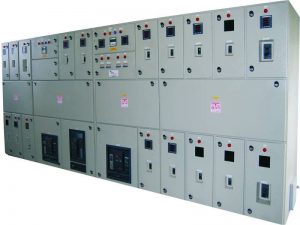
Generally electrical switchgear rated upto 1KV is termed as low voltage switchgear. The term LV Switchgear includes low voltage circuit breakers, switches, off load electrical isolators, HRC fuses, earth leakage circuit breaker, miniature circuit breakers (MCB) and molded case circuit breakers (MCCB) etc i.e. all the accessories required to protect the LV system. The most common use of LV switchgear is in LV distribution board. This system has the following parts
Incomer
The incomer feeds incoming electrical power to the incomer bus. The switchgear used in the incomer should have a main switching device. The switchgear devices attached with incomer should be capable of withstanding abnormal current for a short specific duration in order to allow downstream devices to operate. But it should be cable of interrupting maximum value of the fault current generated in the system. It must have an interlocking arrangement with downstream devices. Generally air circuit breakers are preferably used as interrupting device. Low voltage air circuit breaker is preferable for this purpose because of the following features
1. Simplicity
2. Efficient performance
3. High normal current rating up to 600 A
4. High fault withstanding capacity upto 63 kA
Although air circuit breakers have long tripping time, big size, high cost but still they are most suitable for low voltage switchgear for the above-mentioned features.
Sub – Incomer
Next downstream part of the LV Distribution board is sub – incomer. These sub-incomers draw power from main incomer bus and feed this power to feeder bus. The devices installed as parts of a sub – incomer should have the following features
1. Ability to achieve economy without sacrificing protection and safety
2. Need for relatively less number of interlocking since it cover limited are of network.
ACBs (Air Circuit Breakers) and switch fuse units are generally used as sub – incomers along with molted case circuit breakers (MCCB).
Feeders
Different feeders are connected to the feeder bus to feeds different loads like, motor loads, lighting loads, industrial machinery loads, air conditioner loads, transformer cooling system loads etc. All feeders are primarily protected by switch fuse unit and in addition to that, depending upon the types of load connected to the feeders, the different switchgear devices are chosen for different feeders. Let us discuss in details
• Motor Feeder
• Motor feeder should be protected against over load, short circuit, over current up to locked rotor condition and single phasing.
• Industrial Machinery Load Feeder
• Feeder connected industrial machinery load like oven, electroplating bath etc are commonly protected by MCCBl and switch fuse disconnector units
• Lighting Load Feeder
• This is protected similar to industrial machinery load but additional earth leakage current protection is provided in this case to reduce any damage to life and property that could be caused by harmful leakages of current and fire.
In LV switchgear system, electrical appliances are protected against short circuit and overload conditions by electrical fuses or electrical circuit breaker. However, the human operator is not adequately protected against the faults occurs inside the appliances. The problem can be overcome by using an earth leakage circuit breaker. This operates on low leakage current. The earth leakage circuit breaker can detect leakage current as low as 100 mA and is capable of disconnecting the appliance in less than 100 msec.
A typical diagram of low voltage switchgear is shown above. Here the main incomer comes from LV side of an electrical transformer. This incomer through an electrical isolator as well as an MCCB (not shown in the figure) feeds the incomer bus. Two sub-incomers are connected to the incomer bus and these sub-incomers are protected by means of either switch fuse unit or air circuit breaker. These switches are so interlocked along with bus section switch or bus coupler that only one incomer switch can be put on if bus section switch is in on position and both sub incomer switches can be put on only if bus section switch is at off position. This arrangement is fruitful for preventing any mismatch of phase sequence between the sub – incomers. The different load feeders are connected to any of both sections of the feeder bus. Here motor feeder is protected by thermal overload device along with conventional switch fuse unit. Heater feeder is protected only by conventional switch fuse unit. The domestic lighting and AC loads are separately protected by a miniature circuit breaker along with common conventional switch fuse unit. This is most basic and simple scheme for low voltage switchgear or LV distribution board.